

Eurodad Policy Forum 2026 - The world at a crossroads: Reclaiming global economic governance
Address:
Comet Louise, Place Stéphanie 20, 1050 Bruxelles,
09:00AM-
In-person registration is closed, click here to register to participate remotely (via Zoom)
The Policy Forum takes place at a time of great uncertainty about the economic fallout of the war in Iran, the social consequences of the threatened energy and food crises and the impact of the breakdown of multilateralism on global processes and institutions. There is also anxiety in civil society about funding cuts and shrinking space to fulfil our role effectively.
Together, we will analyse the current challenging context and highlight the opportunities that the global economic justice movement can build on. We will dive into a hopeful and unorthodox but realistic analysis to spark ideas, develop strategies and energise our collective work.
Against a backdrop of ongoing conflicts, the erosion of international law and the weakening of the UN as the democratic global governance space - and in which civil society is operating in an increasingly difficult environment - addressing the interconnected polycrisis has become complex and challenging. Hopes for meaningful reform of global economic governance at the Fourth International Financing for Development Conference (FfD4) in 2025 were ultimately not realised, largely due to the dilution of outcomes by the Global North.
Yet despite the difficult context, there are important opportunities to advance our agenda to democratise global economic governance. 2026 is a crucial year for the negotiation of the UN Framework Convention on International Tax Cooperation. The outcomes will shape global tax rules, impacting the ability of countries—especially in the Global South—to mobilise domestic resources, and it will set the standard in international taxation. Inspired by this, the global debt movement is also stepping up efforts to advance a UN Debt Framework Convention while also campaigning for urgent debt cancellation in the Global South.
The governance framework for international development cooperation will also be under scrutiny this year as the OECD-DAC launches a review of its role. Building on the important collaborations in the run-up to FfD4, the CSO community working on international development cooperation will seek to build a groundswell of support for a “third-way”- a democratic, rules-based, accountable and responsive framework work to replace the current aid system - shaped by the shifting priorities of rich countries and an overreliance on private finance - which itself followed the traditional charity-based aid system tied to colonial legacies.
In Europe negotiations of the next EU development budget (the so-called Multiannual Financial Framework or MFF) for the period 2028-2034 will also reach their final stages this year. This will be a decisive moment for the future of development cooperation in Europe.
Speakers
|
Attiya Waris |
Ryad Selmani
|
|
Everlyn Muendo |
Iggy Sandrino |
 Roos Saalbrink |
|
|
Patricia Miranda |
|
Hamdi Benslama |
Kamal Ramburuth |
|
|
|








Stay tuned, more speakers will be confirmed soon!
In-person registration is closed, click here to register to participate remotely (via Zoom)
Agenda
In-person registration is closed, click here to register to participate remotely (via Zoom)
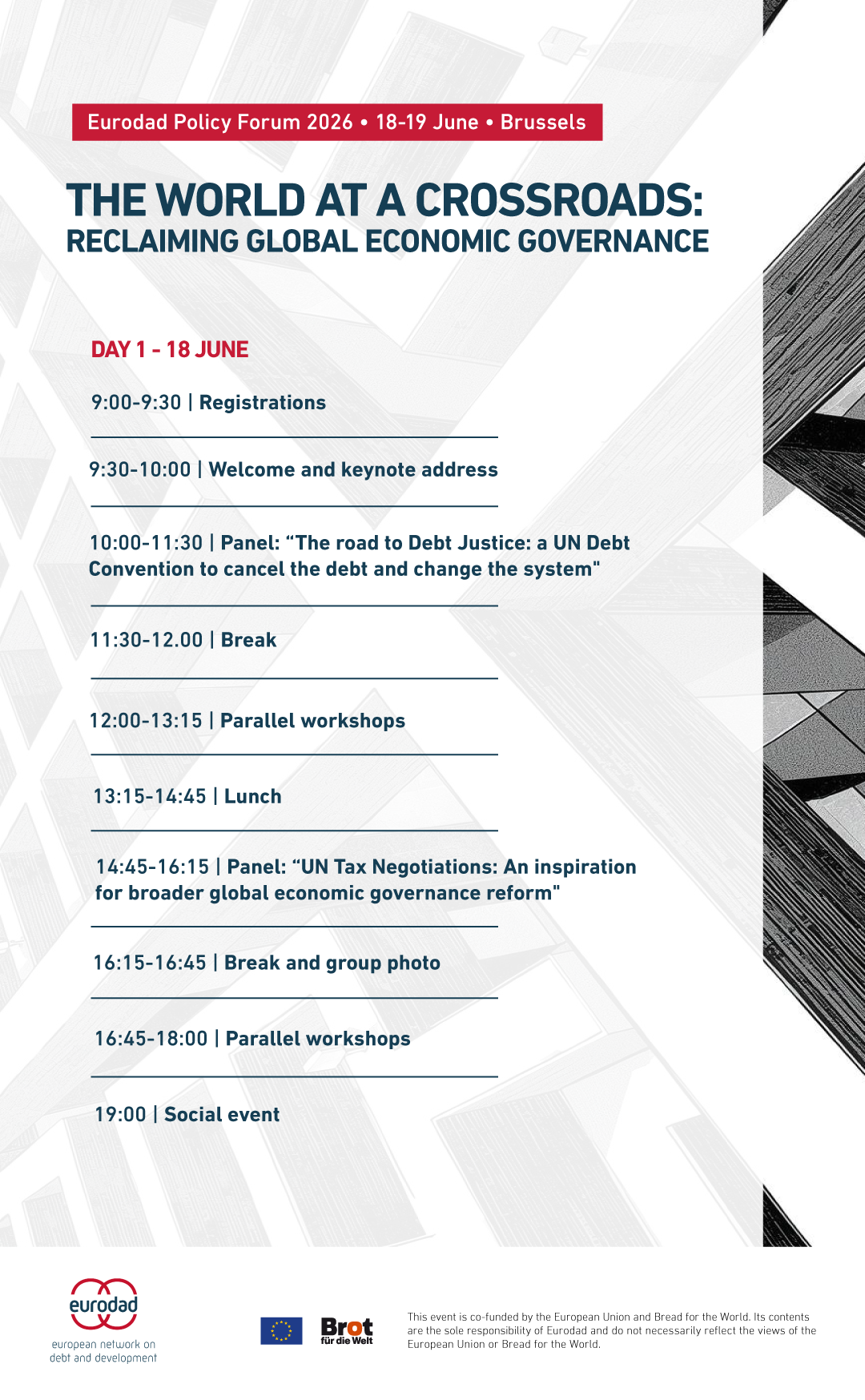
Thursday, 18 June 2026
9.00-9.30 Registrations
9.30-10.00 Welcome and keynote address reflecting on the theme of the Policy Forum
10.00-11.30 Panel 1 "The road to Debt Justice: a UN Debt Convention to cancel the debt and change the system"
Most countries in the Global South struggle today with unsustainable and illegitimate debts. In a full blown debt crisis, exacerbated by geopolitical tensions and the spillovers of the war in Iran, communities in the global south need urgent debt cancellation. But Debt justice is not just about dropping the debt, it’s about changing the system. Reforming global debt architecture is today more urgent than ever. The call from civil society, together with African countries and Small Island Developing States at FfD4 for a UN Framework Convention on Sovereign Debt, is key to the road to debt justice. Leading creditor countries - most notably the EU and UK, oppose any substantial change to the status quo: a debt architecture dominated by creditors. While the “Sevilla Commitment” did not deliver on the changes that civil society advocated for, there were agreements that can help us advance towards the systemic changes needed. It is essential to plot out the roadmap to get the urgent debt relief that many countries need at the same time as we advance towards a UN debt convention. Tackling European and other Global North country blockers is critical to both goals.
11.30-12.00 Coffee break
12.00-13.15 Parallel workshops
Workshop: "A European debt advocacy and campaign strategy - next steps"
In early March 2026, we organised a European debt strategy meeting where a group of Eurodad members discussed and agreed to work towards a European debt campaign, focusing both on advocacy and public awareness/narrative influencing. The session will discuss next steps and also provide an opportunity for participants to engage in the campaign.
This session will be the fourth discussion to prepare this campaign, so it will be based on previous discussions. A concept note, theory of change, and a proposal to discuss slogans and agreed demands will be prepared ahead of the session. While this session will be open to everyone, we expect attendees to be familiar with previous discussions and agreements around the campaign. Please note that the campaign will be targeting European public and policymakers, not global processes.
Workshop: "Implications of the UN at 80 reform agenda: European advocacy needs"
As the UN celebrates its eightieth anniversary, the odds against it could not be stacked up higher. In December 2025, UN Secretary-General Antonio Guterres pointed out that with unpaid dues nearing US$1.6 billion, the UN was in its most fragile financial position in years. Some of the biggest contributors like the US and Russia still have to pay what they owe.
Multilateralism is also under attack, making the complexity of UN operations, meetings and processes even greater than ever before and reducing trust and support for this institution.
In this fragile context, the UN has launched a major reform agenda called ‘UN at 80.’ It consists of a work programme made up of 87 actions, grouped into 31 work packages across 3 workstreams, stretching from peace operations and humanitarian response to technology, shared services and institutional mergers.
Not surprisingly, the UN’s development and gender work are easy targets. Entities that have been the vanguard of the economic governance agenda at the UN, such as UNCTAD and UNDESA, have never enjoyed great support from the Global North in general, European countries included. These entities risk being stripped of capacity and mandate. Under workstream 3 named “Changing structures and realigning programmes,” the following is on the table so far on the reform of the UN development system:
- Sunset the Joint United Nations Programme on HIV/AIDS (UNAIDS) by the end of 2026, mainstreaming capacity and expertise into relevant entities of the United Nations development system in 2027.
- Creating a single entry point for Member States on macroeconomic analysis across the Department of Economic and Social Affairs, the United Nations Conference on Trade and Development (UNCTAD) and the regional commissions to create a unified “single entry point” “anchored in joint mechanisms.”
- Streamlining support for the least developed countries, landlocked developing countries and small island developing States across the Department of Economic and Social Affairs, UNCTAD and the Office of the High Representative for the Least Developed Countries, Landlocked Developing Countries and Small Island Developing States.
As the only global space where all countries have an equal voice and vote, the UN should play a leadership role in global economic governance. A strong UN is essential to support the implementation of the future UN Tax Convention that is currently being negotiated, the establishment of a UN debt convention that we are advocating for and the proper implementation and elaboration of the UN’s Financing for Development agenda. Moreover, UNCTAD has a specific role to play in knowledge creation and expertise, particularly for the benefit of the Global South.
European civil society must be aware of the risks and consequences of the UN at 80 agenda.
This workshop will provide a space to pool intelligence about the role that European countries are playing in the UN at 80 process. The aim is to share and coordinate advocacy strategies to ensure that European countries do not undermine the leadership role of the UN in global economic governance.
13.15-14.45 Lunch
14.45-16.15 Panel 2 "UN Tax Negotiations: An inspiration for broader global economic governance reform"
Collective negotiations on the substance of the UN Convention on International Tax Cooperation kicked off in 2025. The US had already pulled out of the negotiations in February 2025. Its exit drove home the importance of achieving a strong and ambitious negotiated framework convention on international tax cooperation, which reflects a balanced and fair agreement rather than the current ineffective OECD-run model of international tax cooperation (in which a large part of the world has little to no voice or influence, while the US has repeatedly played a major role in drafting rules it doesn't intend to implement). As the process advances into a year of substantive negotiations, this panel will take stock of developments and draw learnings from the challenges the tax justice movement has encountered in advocating for robust modalities with effective civil society engagement. The panel will bring together experts who are closely engaged in the negotiations and will be a source of information and inspiration for other movements seeking global economic governance reform under the auspices of the UN. It will also touch upon the campaign to promote taxation of fossil fuel companies launched earlier this year together with Eurodad members and allies. It is part of the umbrella Era of Justice campaign, with this phase led by CNCD-11.11.11 and Eurodad together with 7 other members.
16.15-16.45 Coffee break
16.45-18.00 Parallel workshops
Workshop: "Eurodad 2026-30 strategy: Feedback on the first draft"
Eurodad is in the final stages of its strategic renewal process. The process started with an extensive mid-term review of our 2021-2025 strategy and various discussions over the course of 2025 that provided the building blocks of the draft of the new strategy, starting with a workshop looking back at the previous strategic period and looking forward to the new one.
Eurodad aims to embark on the next 5-year strategy starting in September 2026. Needless to say, it is a challenging yet exciting time to do so. The polycrisis is deepening and getting more complex in the midst of war, the breakdown of multilateralism, disrespect for international law, a reform agenda that threatens to weaken the UN, among other challenges. Closer to home, civil society has to contend with a hostile environment, political deprioritisation of international solidarity, falling aid budgets and the growing influence of the far-right.
The next 5-year strategy needs to be a steady compass on a stormy sea. It needs to capitalise on the gains we have booked so far as a network and as part of the global economic justice movement. Some of these are becoming a larger network, a stronger economic justice movement with leadership from the global south, new groups and sectors of civil society making the links between tax, debt, climate action, nature protection, feminism, the just socio-ecological transition and stronger partnerships with youth organisations. Politically, we can celebrate the important role that civil society has played in the UN Tax Convention process and in maintaining pressure for global debt and development finance architecture reform.
This workshop will provide participants with an update on the Strategy renewal process. Participants will have an opportunity to reflect on feedback received so far on the first draft of the strategy and provide additional feedback and reflections.
19.00 Social event
Friday, 19 June 2026
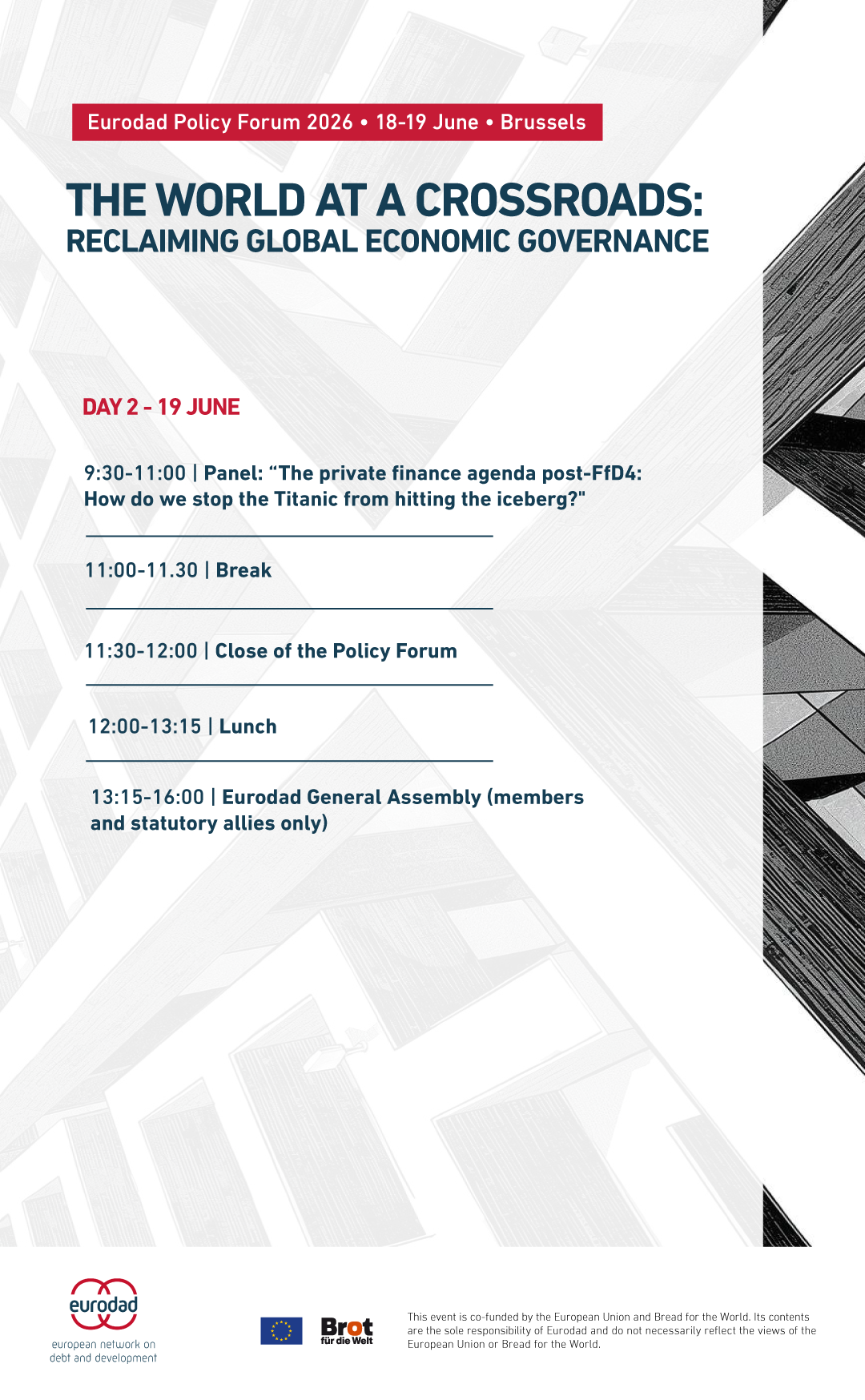
9.30-11.00 Panel 3 "The private finance agenda post-FfD4: How do we stop the Titanic from hitting the iceberg?"
FfD4 became all about fast-tracking private-sector-led development. This agenda, which rests on the notion that private investment will miraculously provide the missing billions that are urgently needed to meet development and climate commitments, continues to be promoted relentlessly. This is despite the fact that the ‘billions to trillions’ agenda of the World Bank a decade ago never materialised.
In this vein, the EU stepped up its Global Gateway strategy in 2025. This included the launch of the Global Gateway Investment Hub, a new platform for European companies to participate more easily in shaping policy priorities and identifying strategic projects. In practice, this is a blow for those who are calling for the Global Gateway to no longer be Brussels-driven and instead more driven by Global South countries themselves. Indeed, the EU seems willing to sacrifice its treaty commitments to eradicate poverty to join the broader shift to turn development into a transaction, continuing centuries of colonial extraction of raw materials. The Global Gateway is set to be the framework for the external dimension of the next MFF.
This panel will consider the ongoing MFF negotiations and the preparations for COP31, as the stalemate continues on vulnerable countries’ proposed target of tripling grant-based public climate finance for adaptation to at least US$120 billion by 2030 as well as the accelerated momentum to reform international development finance architecture. It will highlight opportunities and strategies to protect public finance and ensure that the current agenda takes into account evidence of private finance’s limitations and weaknesses.
11.00-11.30 Coffee break
11.30-12.00 Close of Policy Forum
12.00-13.15 Lunch break
13.15-16.00 Eurodad General Assembly (members and statutory allies only)